


 English
Berita
What Is Coated Canvas Material?
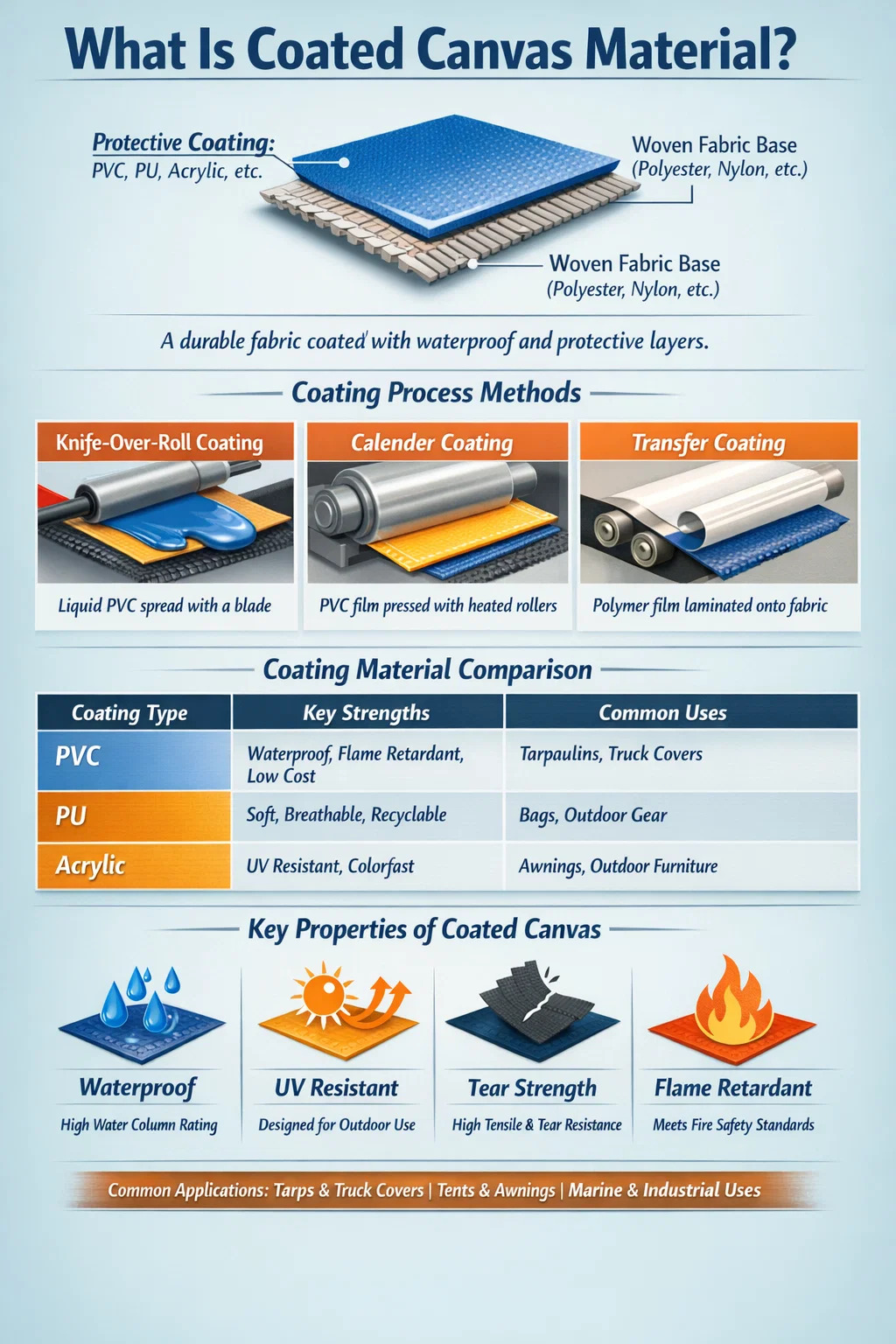
Coated canvas material is a textile product made by bonding or laminating a chemical compound — most commonly PVC (polyvinyl chloride), polyurethane (PU), or acrylic — onto a woven or knitted fabric base. The result is a composite material that inherits the structural strength of the base cloth while gaining an entirely new set of surface properties: waterproofing, UV resistance, chemical resistance, and significantly extended lifespan. In short, coated canvas is engineered cloth, designed to perform in conditions that would destroy untreated fabric within weeks.
The term "canvas" historically referred to a plain-woven, heavy-duty cloth made from cotton, hemp, or linen. Modern coated canvas expands this definition considerably. Today's base fabrics include high-tenacity polyester, nylon, fiberglass, and polypropylene — all of which can be coated. What they share is a tight weave structure that gives the coating something solid to adhere to and prevents delamination under stress.
Among all coating types, PVC coated fabrics dominate industrial and commercial markets, accounting for roughly 60–70% of the global technical textile coating segment by volume. This dominance comes from PVC's unique combination of low raw material cost, wide processing flexibility, and exceptional durability across temperature ranges from -30°C to +70°C. Understanding coated canvas starts with understanding what the coating does — and why different coating chemistries exist for different applications.
How the Coating Process Works
The manufacturing process for coated canvas material varies depending on the coating compound and the intended end use, but there are three dominant methods used at industrial scale.
Knife-Over-Roll Coating
This is the most common method for producing PVC coated fabrics. Liquid PVC paste (a plasticol compound) is spread over the moving fabric using a fixed blade — the "knife." Coating weight and thickness are controlled by the gap between the blade and the fabric. After coating, the material passes through an oven at temperatures between 160°C and 200°C, where the PVC fuses into a continuous film. Multiple coating passes can be applied to build up total thickness, which in finished PVC coated fabrics typically ranges from 300 gsm to over 1,500 gsm depending on the application.
Calender Coating
Calendering presses a pre-formed PVC film onto the base fabric between heated rollers at high pressure. This produces a very uniform surface finish and is widely used for coated canvas intended for printing, signage, and banner applications. The adhesion between film and fabric is achieved through heat and pressure rather than a chemical bond, which means the interface characteristics differ from knife coating — calendered products can sometimes delaminate under sustained stress or at extreme temperatures if the formulation is not well-matched to the substrate.
Transfer Coating
Used primarily for PU coated fabrics and high-performance technical textiles, transfer coating applies the polymer to a release paper first, then laminates it to the fabric. This method produces fine surface textures and is favored for products like synthetic leather, luxury goods coatings, and medical-grade coated canvas. The surface consistency achievable with transfer coating is measurably superior — Ra (surface roughness) values of less than 1 micron are achievable, compared to 5–15 microns with knife-over-roll methods.
Types of Coated Canvas: Comparing Coating Materials
The coating chemistry defines the performance envelope of the finished material. Below is a comparison of the major coating types used in coated canvas production today.
| Coating Type | Typical Weight Range | Key Strengths | Key Limitations | Common Uses |
|---|---|---|---|---|
| PVC (Polyvinyl Chloride) | 300–1,500+ gsm | Waterproof, flame retardant, weldable, low cost | Contains plasticizers, less eco-friendly | Tarpaulins, tents, truck covers, pool liners |
| PU (Polyurethane) | 100–600 gsm | Soft hand feel, breathable variants, recyclable | Higher cost, lower chemical resistance vs. PVC | Outdoor clothing, bags, upholstery, sportswear |
| Acrylic | 200–500 gsm | UV stable, color retention, breathable | Not fully waterproof without additional treatment | Awnings, shade sails, outdoor furniture |
| Silicone | 150–400 gsm | Extreme temperature range (-60°C to +200°C), food safe | High cost, difficult to bond/weld | Industrial gaskets, food processing, fire blankets |
| PTFE (Teflon) | 400–1,200 gsm | Non-stick, chemical inertness, very long service life | Very high cost, heavy | Architecture membranes, conveyor belts, filtration |
PVC coated fabrics sit at the intersection of performance and affordability, which explains why they are used from construction tarps to inflatable boats. PU coated materials occupy the premium mid-market where environmental concerns, skin contact, or aesthetics matter more. Silicone and PTFE are specialist materials where their unique chemistry justifies the substantial cost premium.
PVC Coated Fabrics: A Closer Look at the Market Leader
PVC coated fabrics are not a single product — they are a broad family of materials unified by the use of polyvinyl chloride as the coating compound. Within this family, the performance characteristics vary enormously based on three key variables: the base fabric construction, the PVC compound formulation, and the total coating weight.
Base Fabric: The Backbone
The base fabric in PVC coated materials is almost universally high-tenacity polyester (HTPE), though some specialized products use nylon, glass fiber, or aramid. Polyester's combination of high tensile strength, dimensional stability, low moisture absorption, and favorable adhesion to PVC makes it the default choice. The weave structure matters: a simple 1×1 plain weave at 1,000 denier is common for standard-duty tarpaulins, while architectural membrane fabrics may use a 1,500–3,000 denier yarn in a leno or Panama weave to maximize tear resistance. The thread count (yarns per cm in warp and weft direction) directly affects how evenly the PVC coating is supported and how the fabric behaves under multi-directional stress.
PVC Compound Formulation
Raw PVC resin is rigid and brittle at room temperature. To produce a flexible coated fabric, manufacturers blend it with plasticizers — most commonly phthalate-based or non-phthalate alternatives like DINP (diisononyl phthalate) or DOTP (dioctyl terephthalate). Plasticizer content in a typical PVC coated fabric formulation ranges from 30% to 45% by weight. Higher plasticizer content produces softer, more flexible material but can reduce surface hardness, abrasion resistance, and long-term dimensional stability as plasticizers migrate over time. Additives including UV stabilizers, flame retardants, antimicrobials, and pigments are compounded in during manufacturing to tailor properties for specific end uses.
Coating Weight and Thickness
Total fabric weight (gsm — grams per square meter) is the primary specification metric for PVC coated fabrics in commercial transactions. As a practical reference:
- 300–500 gsm: Lightweight covers, banners, exhibition graphics
- 500–900 gsm: Standard truck side curtains, general-purpose tarps, temporary shelter skins
- 900–1,200 gsm: Heavy-duty tarpaulins, industrial curtains, inflatable structures
- 1,200–1,500+ gsm: Architectural membranes, high-pressure inflatables, marine dock fenders
Thickness in millimeters is related to but not identical to gsm, because density varies with formulation. A 900 gsm PVC coated fabric might measure 0.7–0.9mm, while a heavily plasticized formulation of similar weight could be 1.1mm due to lower density. For applications where dimensional clearance matters — like fabric structures that must fit into mechanical tension systems — thickness specifications need to be called out explicitly alongside weight.
Key Performance Properties of Coated Canvas Materials
When selecting a coated canvas for any application, there are several measurable properties that determine whether the material is fit for purpose. These properties are defined by international standards and should appear on any reputable supplier's data sheet.
Tensile Strength and Tear Resistance
Tensile strength measures how much force the fabric can withstand before breaking, tested in both warp (lengthwise) and weft (crosswise) directions per ISO 1421 or ASTM D751. For a mid-range PVC coated fabric at 650 gsm, expect tensile values in the range of 2,200–3,500 N/5cm. Tear resistance (ISO 4674 or ASTM D2261) measures resistance to propagation of an existing cut — a critical property for applications where punctures or cuts are likely, such as agricultural covers or boat canopies. A coated fabric can have high tensile strength but poor tear resistance if the base fabric weave does not allow individual yarns to shift and redistribute load around a cut.
Waterproofness and Water Column Rating
Waterproofness in coated canvas is expressed as a hydrostatic head value (EN 20811 / ISO 811), measuring the height of water column the fabric can resist before leakage begins. A properly formulated PVC coated fabric is fully waterproof at any practical hydrostatic head value — typically exceeding 5,000 mm water column, and often much higher. This contrasts with DWR-treated (durable water repellent) fabrics, which resist surface wetting but are not truly waterproof. The seams, however, are the weak point: a tent or tarp made from waterproof coated canvas can still leak at needle-punched seams if they are not welded, taped, or sealed.
UV Resistance and Color Fastness
PVC coated fabrics without UV stabilizers degrade rapidly in outdoor exposure: the PVC surface becomes brittle, surface cracking (crazing) begins, and color fades. Quality PVC coated materials incorporate UV stabilizers (typically hindered amine light stabilizers, HALS) and UV-absorbing pigments into the compound. Accelerated weathering tests (Xenon arc, ISO 11341) simulate years of outdoor exposure in hours. A well-stabilized PVC coated fabric will retain more than 80% of its tensile strength after 2,000 hours of accelerated weathering, equivalent to roughly 10–15 years of service in temperate climates with proper maintenance.
Flame Retardancy
PVC inherently contains chlorine, which makes it naturally more fire resistant than polyethylene or polyurethane. However, for applications in temporary structures, event tents, or public buildings, specific fire retardancy standards must be met. Common standards include DIN 4102-B1 (Germany), M2 (France), BS 7837 (UK), and NFPA 701 (USA). A PVC coated fabric passing these tests contains additional flame retardant additives that cause the material to self-extinguish when the ignition source is removed rather than continue burning. Fire certification is non-negotiable for architectural or public-space applications and should always be requested as a certified test report, not just a supplier claim.
Weldability
One major practical advantage of PVC coated fabrics over PU or acrylic coated canvas is weldability. PVC can be joined by hot air welding, high-frequency (RF) welding, or hot wedge welding to form seams stronger than the base fabric. Weld strengths of 90–110% of the parent material tensile strength are routinely achieved in production. This makes PVC coated fabrics the default choice for inflatable products, fluid containment, pool liners, and large structures where long seam lengths must be watertight under pressure. PU and acrylic coated fabrics require adhesive bonding or tape sealing, which is slower and often produces weaker seams.
Where Coated Canvas Material Is Used
The applications for coated canvas span industries, climates, and scales — from a pocket-sized rain jacket panel to a 10,000 square meter stadium roof. The following categories represent the highest-volume end uses globally.
Transportation and Logistics
Truck and trailer side curtains, flatbed tarps, container liners, and railway wagon covers all rely on heavy-duty PVC coated fabrics. The European truck curtainsider market alone consumes tens of millions of square meters of PVC coated fabric annually. These applications demand a material that resists high-speed wind loading, repeated rolling and unrolling, fuel spills, and temperature cycling between -20°C winter temperatures and the interior heat of a sun-baked trailer that can exceed 60°C. Typical specification: 650–750 gsm PVC coated polyester with a breaking strength above 3,000 N/5cm and cold crack temperature below -20°C.
Temporary Structures and Event Infrastructure
Modular tent systems, festival marquees, disaster relief shelters, and military field hospitals all use coated canvas as their primary skin material. PVC coated fabrics in the 500–900 gsm range are standard for commercial event structures, while higher-specification products (1,000+ gsm) are used in semi-permanent structures intended for multi-year deployment. Fire rating is mandatory in most markets for public-gathering structures — any supplier unable to provide third-party fire certification documentation should be disqualified from procurement.
Agriculture and Aquaculture
Grain storage bags, silage bunker covers, fish pond liners, irrigation channel liners, and greenhouse films are all derivatives of coated canvas technology. Agricultural applications often demand antifungal and antimicrobial additives in the PVC coating to prevent mold growth in high-humidity storage environments. Fish pond liners and irrigation channel liners must meet food safety or drinking water standards (e.g., contact with potable water per EN 1186 or WRAS approval in the UK), which requires careful selection of PVC stabilizer chemistry — tin-based stabilizers are typically replaced with calcium-zinc systems in these contexts.
Architecture and Construction
Tensile architecture — stadium roofs, airport canopies, covered walkways, and iconic landmark structures — uses PTFE-coated glass fiber or high-specification PVC coated polyester membranes. These materials must sustain service lives of 20–30+ years under constant outdoor exposure without significant loss of mechanical properties. The Millennium Dome (now The O2) in London, for example, uses a PTFE-coated glass fiber membrane spanning 365 meters. For commercial architectural applications where cost matters more than ultimate longevity, lacquered PVC coated fabrics with PVDF (polyvinylidene fluoride) topcoats offer a middle ground — service life of 15–20 years with significantly better economics than PTFE.
Marine and Outdoor Recreation
Inflatable boats (RIBs), life rafts, inflatable kayaks, sailboat sails, and marine covers use coated canvas extensively. Marine applications are among the most demanding: the material must resist seawater, UV radiation, mechanical abrasion from ropes and fittings, and repeated inflation cycles without fatigue cracking. Most inflatable marine products use either PVC or Hypalon (CSM — chlorosulfonated polyethylene) coated fabrics. Hypalon-coated fabrics cost 3–5 times more than equivalent PVC but offer superior UV resistance and can be repaired in the field with solvent-based adhesives — a critical maintenance advantage in remote or offshore conditions.
Coated Canvas vs. Laminated Fabric: Understanding the Difference
The terms "coated" and "laminated" are sometimes used interchangeably in the market, but they describe different construction methods with different performance implications.
Coated fabric: A liquid or paste compound is applied directly to the fabric surface, penetrating the weave structure to some extent. The coating and base fabric are chemically and mechanically bonded at the interface. This produces a single unified composite where the coating cannot be separated from the fabric without destroying both.
Laminated fabric: A pre-formed film is bonded to the fabric using adhesive or heat. The film and fabric remain two discrete layers. Laminated constructions are faster and cheaper to produce but are more susceptible to delamination — particularly at the edges, after prolonged flexing, or when adhesive degrades due to UV or chemical exposure. Many budget "PVC coated" fabrics sold in commodity markets are actually laminated — the distinction matters enormously for applications involving sustained mechanical stress or long service life.
A simple field test: flex the fabric sharply and look at the edge cross-section. In a properly coated fabric, the PVC integrates into the fabric weave and the cross-section shows no visible interface line. In a laminated product, the film and fabric separate cleanly, showing a distinct layer boundary. This structural difference translates directly into performance, particularly for seam welding: laminated PVC fabrics often weld inconsistently because the adhesive layer disrupts the RF welding process.
Environmental Considerations for Coated Canvas Materials
Environmental concerns around PVC coated fabrics specifically have driven significant R&D investment in the industry over the past decade. The issues are real but nuanced.
Plasticizer Migration and REACH Compliance
The European REACH regulation restricts certain phthalate plasticizers (DEHP, DBP, BBP, DIBP) in articles where they may come into contact with the skin or be used in children's products. Most reputable manufacturers of PVC coated fabrics have migrated to non-restricted plasticizers (DINP, DOTP) for consumer-facing applications. For industrial applications — truck covers, construction tarps — the plasticizer migration risk is minimal in practical use, though procurement teams for public contracts should still verify REACH compliance documentation.
Recyclability and End-of-Life
PVC coated fabric is technically recyclable — both the PVC compound and the polyester fiber can be recovered. However, separation of the two materials is currently not economically viable at industrial scale with most existing processes. The practical reality is that the majority of end-of-life PVC coated fabric goes to landfill or incineration. Several European industry initiatives (including the Serge Ferrari "Préférence" recycling program and the Sioen Industries closed-loop programs) are working to establish take-back and mechanical recycling infrastructure, but coverage remains limited. PU coated fabrics are generally more recyclable as the PU can be delaminated from the base fabric more easily in controlled processes.
Bio-Based and PVC-Free Alternatives
A growing niche of bio-based coated fabrics is emerging, using natural rubber, bio-PU derived from agricultural waste streams, or water-based polyolefin dispersions. These materials are not yet price-competitive with conventional PVC coated fabrics — typically carrying a 30–80% cost premium — and have not yet proven equivalent durability in long-term outdoor use. For applications where sustainability certification (GOTS, Bluesign, Oeko-Tex) is a procurement requirement or a market differentiator, PU or bio-based alternatives merit serious evaluation despite the higher cost.
How to Evaluate and Specify Coated Canvas for a Project
Choosing the right coated canvas requires translating application requirements into material specifications. The following questions should guide any serious procurement exercise:
- What are the mechanical loads? Define tensile, tear, and puncture requirements based on the worst-case loading scenario, not average use.
- What is the exposure environment? UV intensity varies enormously — a product installed in southern Spain or Arizona needs higher UV stabilizer loading than one used in northern Europe or indoor conditions.
- What temperature range must the material survive? Cold crack temperature is critical for outdoor use in continental climates where winter temperatures regularly drop below -20°C.
- Are there regulatory requirements? Fire rating, food contact, drinking water contact, and chemical resistance standards vary by jurisdiction and application type.
- How will the fabric be joined? If seam strength is critical, specify weldable PVC coated fabric and confirm the fabricator's welding process parameters.
- What is the expected service life? A temporary installation lasting one season has very different requirements from a permanent structure expected to last 15 years with minimal maintenance.
Always request independent test data (not just specification sheets based on the manufacturer's internal testing) for critical properties. ISO or ASTM test methods should be specified, and certificates from accredited third-party laboratories (ISO 17025 accredited) carry meaningfully more weight than self-reported test results.
Caring for and Maintaining Coated Canvas
The longevity of coated canvas is as much a function of maintenance practice as it is of initial material quality. PVC coated fabrics are robust but not indestructible.
Cleaning
Most PVC coated fabrics can be cleaned with mild soap (pH 6–8) and water using a soft brush. Avoid solvents, petroleum-based cleaners, or highly alkaline products — these attack the plasticizer system and accelerate surface degradation. For heavy biological contamination (mold, algae), a dilute bleach solution (maximum 2% sodium hypochlorite) is effective but should be thoroughly rinsed afterward. Pressure washing at high pressure should be avoided on coated fabrics — it can drive water into the seams, delaminate edge finishing tape, and accelerate surface wear.
Storage
Long-term storage of coated canvas should be done clean, dry, and loosely rolled (not folded) to prevent permanent crease marks. Store away from ozone sources — electric motors, UV lamps, and fluorescent lighting all generate ozone that attacks the polymer surface of PVC and PU coated fabrics over time. Storage temperature ideally between 10°C and 25°C; avoid locations where temperatures will regularly exceed 50°C.
Repair
Small punctures and tears in PVC coated fabric can be repaired effectively in the field using PVC adhesive patches of the same or slightly heavier weight. Clean and degrease the repair area, apply adhesive to both surfaces, allow to tack off, then press firmly. For permanent structural repairs, hot-air welded patches applied by a qualified fabricator produce weld-strength joints that restore full material integrity. Silicone and PTFE coated fabrics are significantly harder to repair and typically require factory-level processing for reliable bonding.
 Sebelumnya


